
Depending on your career interests and goals, you may need to complete a new education or training programme in Switzerland. However, the Swiss education system differs in some respects from those of other countries. As a result, the profession you wish to pursue may be taught at a different level of education in Switzerland. For example, some professions are learned through a vocational apprenticeship rather than at a university.
Education and training require time, commitment and money. It is therefore important to seek comprehensive advice before making a decision. A consultation with career guidance specialists can help you find a suitable education or training programme. Together, you can assess whether the programme matches your existing skills and qualifications and offers good prospects on the Swiss labour market.
Below, you will find important information and points of contact to help you learn more about education and training opportunities in Switzerland.
-
The Swiss education system
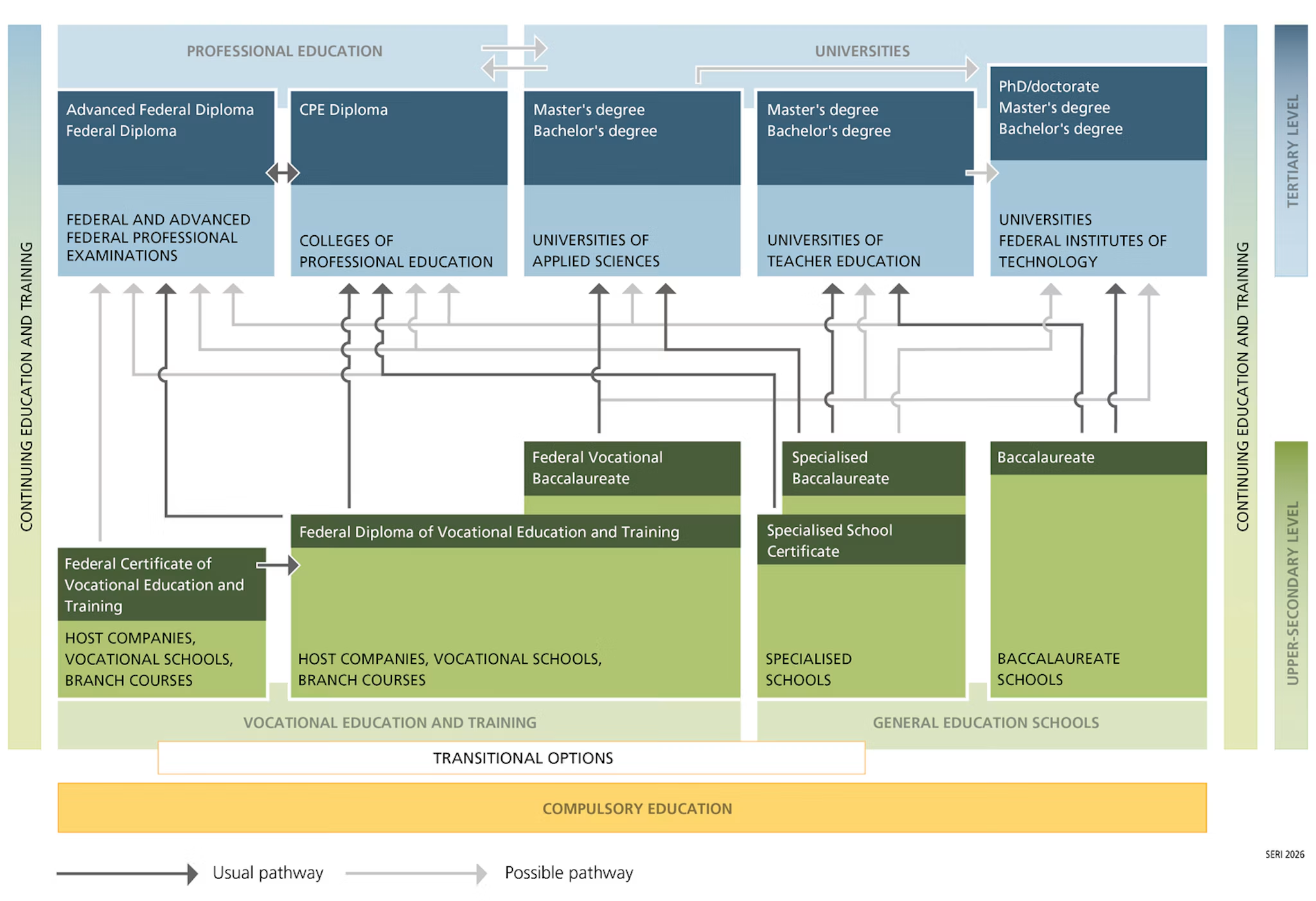
The Swiss education system offers a wide range of opportunities and is highly flexible. Different educational pathways are interconnected, making it possible to move from one pathway to another.
A university degree is not the only route to good career prospects. An important part of the Swiss education system is initial vocational education and training (VET), also known as vocational training or an apprenticeship. It is practice-oriented and combines on-the-job training in a company with theoretical instruction at a vocational school.
The different educational pathways lead to recognised qualifications and provide access to further education and training. For example, it is possible to pursue a university degree after completing a vocational apprenticeship.
The Swiss education system is flexible: Anyone who wishes to do so and meets the relevant requirements can undertake further education or change their educational pathway at any stage.
This video, from Perspectives – Studies, explains the basics of the Swiss education system. You can display subtitles in various languages via the settings menu.
SwissSkills offers further explanatory videos on the Swiss education system in various languages: German, French, Italian, English, Albanian, Spanish, Serbian and Turkish.
The Berufsberatung.ch website features an interactive diagram of the Swiss education system. It also provides information in various languages.

-
Training pathways after compulsory schooling
Vocational apprenticeship (basic vocational education and training)
A vocational apprenticeship is the most common educational pathway in Switzerland. It combines practical training in a company with theoretical instruction at a vocational school.
Preparation for vocational training
For refugees and migrants who did not complete their compulsory schooling in Switzerland, most cantons offer an integration pre-apprenticeship (INVOL). This usually lasts one year and prepares participants for a subsequent vocational apprenticeship by strengthening their language skills and subject-specific knowledge.
Vocational apprenticeship
The duration of the vocational apprenticeship depends on the chosen occupation and the qualification you are aiming for. In many occupations, it is possible to obtain a Federal Vocational Certificate (EBA) after two years or a Federal VET Diploma (EFZ) after three or four years.
During the apprenticeship, apprentices receive a salary. Depending on the occupation and the year of the apprenticeship, this amounts to approximately CHF 500 and 1100 CHF per month.
During or after an EFZ vocational apprenticeship, it is possible to take the vocational baccalaureate. This qualifies students for entry to a related field of study at a university of applied sciences. With an additional bridging programme, it is also possible to gain access to a university.
The State Secretariat for Migration (SEM) has produced explanatory videos on vocational training in various languages.
Further information on vocational apprenticeships, as well as an overview of available apprenticeship positions, can be found at berufsberatung.ch.
Upper secondary specialised school
Upper secondary specialised schools provide a broad general education as well as specialist knowledge in specific occupational fields. They also promote personal and social skills. The programme usually lasts three years and leads to a Swiss-recognised upper secondary specialised school certificate. A vocational baccalaureate can be obtained by completing an additional year of study.
Specialised secondary schools prepare pupils for further training in various professional fields, particularly in the areas of health, social work and education. A specialised secondary school leaving certificate provides access to certain training programmes at Higher Technical Colleges (HF). A specialist school-leaving certificate, on the other hand, opens up the possibility of studying certain degree programmes at universities of applied sciences.
Further information on upper secondary specialised schools.
Gymnasium (cantonal school)
Gymnasiums are part of upper secondary education and lead to the Swiss Matura. Depending on the canton, they are referred to as a Gymnasium, Kantonsschule or Kollegium.
The Swiss Matura generally qualifies students for direct admission to universities, the Swiss Federal Institutes of Technology (ETH Zurich and EPFL), and universities of teacher education. Depending on the degree programme, there may be additional admission requirements. Admission to a university of applied sciences usually requires an additional one-year work placement.
Further information on the Gymnasium can be found at berufsberatung.ch.
-
Tertiary education pathways (universities)
Universities and Swiss Federal Institutes of Technology (ETH)
Universities and the two Swiss Federal Institutes of Technology (ETH Zurich and EPFL) primarily provide theoretical knowledge, analytical skills and training in scientific methods.
A university degree does not usually provide direct vocational training. Depending on the field of study, graduates have access to a wide range of career opportunities. In many fields, a Master’s degree is generally required for entry into the labour market.
Admission to a Bachelor’s degree programme usually requires a recognised upper secondary school leaving certificate (Matura) or an equivalent foreign qualification. Admission requirements vary depending on the applicant’s previous education and the country in which the qualification was obtained.
Further information on admission can be found here.
Further information on Swiss universities can be found at:
- Career guidance
- Eduwo
- Swissuniversities (list of accredited Swiss universities)
Universities of Applied Sciences (FH)
Universities of applied sciences offer a wide range of degree programmes with a strong focus on professional practice. They combine academic knowledge with theoretical and practical training in various professional fields.
Students usually graduate with a Bachelor’s degree, which generally enables them to enter the workforce directly. Depending on the field of study, Master’s degree programmes are also available.
Admission to a degree programme at a university of applied sciences depends on your previous education and the chosen field of study. Depending on your qualifications, additional professional experience or other requirements may be necessary.
Further information on admission requirements can be found here.
Further information on universities of applied sciences (FH) can be found at:
- Career guidance
- Eduwo
- Swissuniversities (list of accredited Swiss universities of applied sciences)
Universities of Teacher Education (PH)
Universities of teacher education offer programmes for teachers, as well as other educational professions.
The programmes are highly practice-oriented and tailored to the respective professional fields. Depending on the programme, graduates receive a Bachelor’s or Master’s degree. Graduates of teacher education programmes also receive a corresponding teaching diploma. This teaching diploma enables the holder to teach throughout Switzerland.
Admission requirements vary depending on the degree programme and prior education. Additional requirements may apply to those with foreign qualifications, such as an aptitude assessment, sufficient proficiency in the language of instruction or a supplementary examination.
Further information on admission can be found here.
Further information on universities of teacher education can be found at:
- Career guidance
- eduwo
- Swissuniversities – List of accredited Swiss universities of teacher education
-
Training pathways after compulsory schooling
-
Advice on careers, studies and professional development
Every canton has advice centres for careers, studies and professional development. These are often called Career Guidance and Information Centres.
These advice centres provide information on different education and training opportunities and help you assess your situation and plan your next steps. You can also discuss questions about the recognition of qualifications and your prospects on the Swiss labour market during a consultation. For young people, consultations are usually free of charge in their canton of residence. People receiving social assistance can generally also access these services free of charge. Some advice centres offer specialised services for migrants.
In some cantons, there are separate advice centres for vocational and academic matters. Vocational guidance centres, for example, provide information on careers and apprenticeships, whilst academic advice centres offer support with questions relating to university studies.
Many cantons have advice centres at several locations. In some cases, you can also explore different careers and education and training opportunities there independently.
You can find an overview of advice centres in the various cantons online.
Further information
- Fields of study and degree programmes
- Education and further training at universities
- Study in Switzerland
-
University open days
Most universities in Switzerland organise open days and specific information sessions. These events give you the opportunity to speak directly with students who are already studying your chosen subject. Lecturers often also give presentations about the various degree programmes.
Further information can be found directly on the website of the relevant university.
Swissuniversities also provides an overview of upcoming open days and other information events in the section Massnahmen für Gymnasiastinnen und Gymnasiasten.
-
Coaching services
Some cantons, municipalities and charitable organisations offer coaching programmes for refugees and migrants with professional qualifications. These programmes often complement the support provided by a social worker. Following a joint assessment, goals are set for further education and training, catching up on missed education or entering the labour market. A coach supports individuals in achieving these goals and supports them in taking the next steps.
It is often not possible to register for coaching support independently. Registration is usually arranged through a social worker or the relevant case management service. In several cantons in German-speaking Switzerland, for example, the HEKS MosaiQ programme offers this type of support. In French-speaking Switzerland, for example, the Association découvrir offers similar support.
There are also various regional coaching programmes.